
Every time you open an app, check your email, or even just scroll through social media, you’re leaving behind a trail of personal data. It’s not just advertisers watching - governments, hackers, and even your own phone company are collecting details about where you go, who you talk to, and what you care about. Protecting your privacy isn’t about going off the grid. It’s about making smart choices that stop strangers from knowing too much about you. And yes, it’s still possible to stay connected without giving up your secrets.
Some people turn to niche services for anonymity, like escord paris, which offer discreet interactions under strict confidentiality. While that’s a very specific use case, it shows how deeply people value privacy in different areas of life - whether it’s personal relationships or digital footprints. The same principle applies online: if you don’t want someone seeing your activity, you need to control the access points.
Start with your phone
Your smartphone is the most powerful spy device you carry every day. It knows your location, your contacts, your browsing habits, even your sleep patterns. Start by turning off location services for apps that don’t need them. Go to Settings > Privacy > Location Services on iOS or Settings > Location on Android. Look at each app and set it to "Never" unless it’s a map or ride-share app. For example, your weather app doesn’t need to track you 24/7.
Also, disable ad tracking. On iPhone, go to Settings > Privacy & Security > Apple Advertising and toggle off "Personalized Ads." On Android, open Google Settings > Ads and enable "Opt out of Ads Personalization." These steps won’t stop all tracking, but they cut off a major source of data collection.
Use encrypted messaging
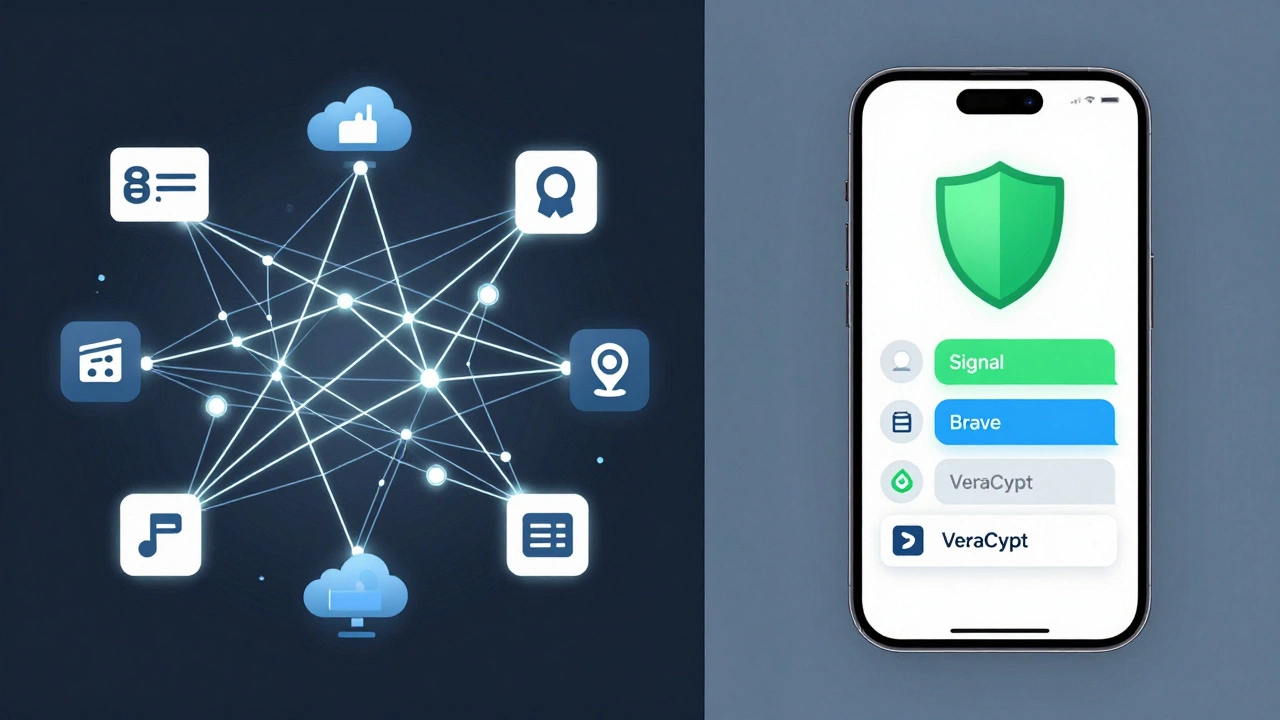
Text messages sent through regular SMS are not private. They’re stored on your carrier’s servers and can be accessed by third parties. Switch to Signal. It’s free, open-source, and end-to-end encrypted by default. No one - not even Signal’s own team - can read your messages. You can still message people who don’t use Signal; they’ll get an SMS, but you’ll know your side is protected.
Group chats, voice calls, and even file sharing in Signal are encrypted too. It’s the most trusted app for privacy among journalists, activists, and security experts. If you’re serious about keeping conversations private, this is the first real step.
Switch to a privacy-focused browser
Chrome and Safari are great for speed, but they’re built to track you. Try Brave or Firefox with strict tracking protection turned on. Brave blocks ads and trackers by default, and it even pays you in cryptocurrency for viewing optional privacy-respecting ads - a clever way to flip the script on data harvesting.
In Firefox, go to Settings > Privacy & Security and set "Enhanced Tracking Protection" to "Strict." This blocks cookies from social media trackers, fingerprinters, and cryptominers. You’ll notice websites load faster, too, because they’re not loading dozens of hidden scripts.
Use a password manager
Reusing passwords is the #1 reason people get hacked. If one site gets breached, attackers try that same password everywhere - your email, bank, social media. A password manager solves this. Use Bitwarden (free) or 1Password. They generate strong, unique passwords for every account and store them securely. You only need to remember one master password.
Enable two-factor authentication (2FA) everywhere you can. Use an authenticator app like Authy or Google Authenticator, not SMS. SMS-based codes can be intercepted. Authenticator apps work offline and are much harder to hack.
Limit what you share on social media
Posting your vacation photos with geotags? That tells strangers exactly when you’re not home. Sharing your pet’s name? That’s often used as a security question. Even something as simple as posting "Happy birthday!" with your full name and birth year gives identity thieves enough info to open accounts in your name.
Go through your profiles and delete old posts that reveal personal details. Set your accounts to private. Review who can see your future posts - don’t let "Public" be the default. Turn off facial recognition on Facebook and Instagram. These platforms scan your photos to build a profile of your friends and family - without your consent.
Encrypt your files and backups
Most people back up their phones and computers to the cloud. iCloud and Google Drive are convenient, but they’re not encrypted by default in a way that only you can access. Use VeraCrypt to create encrypted containers on your hard drive for sensitive documents. For cloud backups, use Cryptomator. It encrypts your files before they’re uploaded, so even if the cloud provider gets hacked, your data stays safe.
Same goes for your phone. On iPhone, enable full-disk encryption by setting a strong passcode (not 1234). On Android, go to Settings > Security > Encryption & credentials and make sure encryption is turned on. It’s usually enabled by default on newer devices, but check anyway.
Be careful with public Wi-Fi
Connecting to free Wi-Fi at cafes or airports is risky. Hackers can set up fake networks with names like "Free Airport WiFi" to steal your login details. Always use a VPN when on public networks. NordVPN and Mullvad are good options - they encrypt your traffic so no one can see what you’re doing.
Even better? Use your phone’s hotspot instead. It’s more secure than public Wi-Fi, and most mobile plans now include unlimited data. You don’t need to risk your banking login just to check your email.
Regularly check what’s known about you
Search your name on Google. See what comes up. If you find old forum posts, outdated contact info, or photos you didn’t approve, you can request removal. Google lets you ask to remove personal info from search results. You can also use services like DeleteMe or OneRep to help scrub your data from data broker sites - though these cost money.
Another trick: search your email address on haveibeenpwned.com. It tells you if your details were leaked in past data breaches. If you see a match, change that password immediately - even if you think the site wasn’t important.
Use burner accounts when needed
Signing up for a free trial? Use a temporary email from ProtonMail or 10MinuteMail. Don’t give your real email or phone number. Need a new social account for a one-off project? Create it with a fake name and no personal info. You don’t need to be your real self everywhere online.
Some people even use separate devices for different activities - like an old tablet just for browsing news or streaming. It keeps your main phone clean and reduces the risk of cross-contamination if one app gets compromised.
Don’t ignore physical privacy
Privacy isn’t just digital. Someone with a long-range microphone can pick up conversations through windows. A camera on your smart doorbell can be hacked. Cover your laptop camera with a sticker or sliding cover. Disable smart speakers when not in use - they’re always listening, even when you think they’re off.
Shred documents with personal info before throwing them out. Bank statements, medical bills, old ID cards - all of it can be used for identity theft. A cross-cut shredder is cheap and worth the investment.
Privacy is a habit, not a one-time fix
You won’t protect your privacy by doing one thing perfectly. It’s about layering small changes over time. Start with one step this week - maybe turning off location tracking for three apps. Next week, switch to Signal. In a month, set up a password manager. Slowly, your digital life becomes harder to track, and you regain control.
And if you ever feel overwhelmed, remember: you don’t need to be perfect. You just need to be better than you were yesterday. Most people don’t even try. You’re already ahead by reading this.
Some services, like tescorte paris, operate under strict privacy policies because their users demand it. That’s the mindset you should adopt: if it’s not necessary for someone to know, then they shouldn’t be able to find out.
And if you’re ever curious about how much data companies have on you, try searching for "data request" on your Google or Facebook account. You can download your entire history - and you might be shocked by what you see. That’s your wake-up call. Now you know what to fix.
Finally, don’t fall for the myth that "I have nothing to hide." Privacy isn’t about hiding secrets. It’s about having the right to choose who sees what, when, and why. Just like you wouldn’t let a stranger walk into your bedroom, you shouldn’t let corporations or hackers walk into your digital life.
And yes, escorte gil exists - not because people want to be exposed, but because they want to be unseen. The same logic applies to your data. You deserve the same level of discretion.
 Sports Analysis